









9 best Bland AI alternatives in 2026, compared (prices checked)
We compared 9 Bland AI alternatives on price, voices, speech-to-speech, outbound calls and compliance. Bland now costs 14¢ a minute plus phone time.

Short answer: For most small businesses, SmallForce is the best Bland AI alternative. You get an AI receptionist answering your number in about five minutes, with the phone line, speech-to-speech voices, calendar booking and a hand-off to your team included. If your team has engineers and runs outbound calls at volume, Bland is still a strong pick and you may not need to move.
Here’s the best choice for each kind of buyer:
- Best for small businesses that need their phone answered: SmallForce
- Closest like-for-like swap for outbound work: Retell AI
- Best for developers who want to choose every part: Vapi
- Best voices and voice cloning: ElevenLabs Agents
- Build it yourself on your own stack: Twilio ConversationRelay
- Large, multilingual contact centers: PolyAI
- A flat price per caller for trades: Goodcall
- Cheapest published way to start: Dialzara
- Sales-led enterprise rollout: Synthflow
Try it now: call Sophie, our demo receptionist, or start your own SmallForce receptionist.
Written by SmallForce’s founder. This compares published prices and documented features, not measured call quality. Prices were checked November 16, 2026; Retell’s telephony details were rechecked November 17.
What changed at Bland
Many “Bland AI review” posts still describe Bland as it was before these three changes:
- The price went up. Until December 5, 2025, every self-serve plan paid a flat 9¢ a minute. Now the free Start plan pays 14¢ and the $299 Build plan pays 12¢. That’s a 56% rise on Start.
- Phone time is billed separately. Bland’s pricing page now says telephony is billed “at pass-through cost.” It doesn’t publish that rate.
- The builder was replaced. In September 2026 Bland relaunched as Bland Agents and moved Conversational Pathways under “Legacy.” Every production agent had to be migrated by November 15, 2026.
Bland’s own homepage title now reads “Enterprise Voice AI Platform.” Its docs name healthcare, insurance, financial services and logistics. That’s who it’s built for, and it’s the first thing to weigh.
Bland AI alternatives compared
| Best for | Price to start | Speech-to-speech | Outbound calls | Sign up online | |
|---|---|---|---|---|---|
| Bland AI (today) | Enterprise phone work, outbound at volume | Free plan; 14¢/min plus phone time | None found | Yes | Yes |
| SmallForce (our pick) | Small businesses that need calls answered | $199/month; from 12¢/min on the phone (line included), 10¢ on your website | Yes | No | Yes |
| Retell AI | Leaving Bland for outbound work | 5.5¢/min plus model, voice and phone (7–31¢ before phone) | Yes | Yes | Yes |
| Vapi | Developers who want to choose every part | 5¢/min plus each provider (about 8–13¢ all in) | Yes | Yes | Yes |
| ElevenLabs Agents | Natural voices and cloning | Free for 15 min; 8¢/min plus model and carrier | Yes | Yes | Yes |
| Twilio ConversationRelay | Engineers already on Twilio | 7¢/min plus Twilio voice and your own model | Only if you build it | Yes | Yes |
| PolyAI | Large multilingual contact centers | Not published | Partly | Yes | Trial; production through sales |
| Goodcall | Trades that want a predictable bill | $79/month for 100 callers | Not stated | Not stated | Yes |
| Dialzara | The cheapest published start | $29/month for 60 minutes | Not stated | Separate plans from $750/month | Yes |
| Synthflow | Sales-led enterprise rollouts | Annual contract | None found | Enterprise | No |
The prices use different units: per minute, per caller and per month. The sections below explain each one. Sources: each company’s pricing page and docs, linked in its section, checked November 16, 2026.
SmallForce comes ready to answer a small business’s phone with speech-to-speech voice options, a choice of model on Standard and Cartesia, and a receptionist that also works on your website. See how it works, or keep reading for the details.
1. SmallForce: best for small businesses that need their phone answered
SmallForce gives you an AI receptionist that answers a local number, included in the plan, in about five minutes. It talks on speech-to-speech voices, you choose the model behind it, and the same receptionist can answer on your website by voice or as a video receptionist. AI employees handle the work in your other apps.
Bland AI vs SmallForce at a glance
| Bland AI | SmallForce | |
|---|---|---|
| Built for | Enterprise phone operations | Small businesses and the people who run them |
| Time to a working receptionist | Build an agent, then promote it to Production | About five minutes |
| Monthly fee | $0 (Start) or $299 (Build) | $199, or $59 weekly, with a private HQ, 50 GB storage, every AI employee, a local number and 5 connected accounts |
| Per minute | 14¢ (Start), 12¢ (Build), plus phone time | From 12¢ on the phone, phone time included; from 10¢ on your website |
| Phone number | $15/month each (one with signup) | One US or Canadian number included, extras $4/month |
| Speech-to-speech voices | None found in Bland’s docs | Phonic, Gemini Live, GPT-Live, Premium |
| Choose your AI model | No model setting | 3 text models for calls, 100+ for AI employees |
| Stock voices | Not published | 178 across six engines |
| Voice cloning | 10-second sample; 1 clone on Start, 5 on Build | From the dashboard, with a recorded consent script |
| Book appointments mid-call | Cal.com, Calendly integrations; scheduling node is Enterprise | Google Calendar or Outlook, on every plan |
| Video receptionist | None found in Bland’s docs | 180 avatars, from 24¢ a minute |
| On your website | Web widget and Web Agent SDK | Floating, docked or inline; voice or video; can guide visitors around the page |
| After the call | Dispositions, extractors and a post-call webhook; outcomes are Enterprise | Summary, outcome and your own questions on every call, and workflows your AI employees run in your apps |
| Hand off to a person | Transfer to a number; warm transfer is Enterprise | Rings your team in the dashboard or the free iPhone app |
| Outbound and batch calls | Yes | No |
| SMS | Enterprise and Agent Phone plan | No |
| Visual flow builder | Yes | No |
Sources: bland.ai/pricing, docs.bland.ai/platform/billing, docs.bland.ai/tts/voices and docs.bland.ai/agents/agent-builder, checked November 16, 2026.
A receptionist answering your number in five minutes
Bland is a platform you build on. Its new agent builder has development, staging and production environments, versions, branches and evaluation gates. That’s the right shape for a bank. Bland’s own docs carry the warning that comes with it: “An agent that has not been promoted to Production will not answer calls.”
SmallForce starts from the other end. You sign up, tell the receptionist about your business, pick a voice, and claim your number. One local US or Canadian number is included with every plan, so there’s no carrier account to open and no $15 monthly number fee. From there it takes about five minutes until you can call your new number and hear your receptionist answer.
You can make it smarter later by adding your services, prices and FAQs to its knowledge base, connecting your calendar, and adding custom tools. None of that has to happen before it starts taking calls.
Speech-to-speech, in plain words
Most voice agents, Bland included, work like a relay race. One model turns the caller’s words into text. A language model writes a reply. A third model reads the reply out loud. Every hand-off adds a little waiting, and everything the caller’s voice carried besides the words is gone after the first leg.
A speech-to-speech model skips the relay. It takes the caller’s audio in and sends audio back, so there’s one model listening and talking instead of three passing notes.
Bland’s docs describe separate speech-to-text, language and text-to-speech models, all built in-house. We found no speech-to-speech option. Its latency claims also depend on which page you read: “sub-200ms” on bland.ai, “sub-400ms” in the docs, “sub-second” on its AI information page.
SmallForce gives you both kinds and lets you pick per receptionist:
| Voice engine | How it works | Phone, per minute | Website, per minute |
|---|---|---|---|
| Standard | Relay: Deepgram listens, your chosen model writes, Deepgram speaks | 12¢ | 10¢ |
| Cartesia | Relay, with Cartesia voices | 12¢ | 10¢ |
| GPT-Live | Speech-to-speech, OpenAI’s gpt-live-1 | 14¢ | 12¢ |
| Gemini Live | Speech-to-speech, Google’s live model | 18¢ | 16¢ |
| Phonic | Speech-to-speech, 50+ languages | 20¢ | 18¢ |
| Premium | Speech-to-speech (Rime), English only | 20¢ | 18¢ |
The speech-to-speech voices handle spoken audio directly rather than using Standard’s separate transcription and text-to-speech stages. They can still use tools during a call: check your calendar and book, search your knowledge base or ring your team. Speech-to-speech starts at 14¢ a minute on the phone.
New receptionists start on Phonic. Callers can cut in mid-sentence on every engine, and the receptionist stops and listens. Website calls cost 2¢ a minute less on every voice, because there’s no phone line to pay for.
You can hear the difference below. Sophie answers the phones for Maple & Main Plumbing, a made-up company, and runs on Phonic, the same default a new account gets. Call her, interrupt her, ask something she shouldn’t know.
Sophie at Maple & Main Plumbing
Loading the demo line…
You choose the model
Bland runs its own closed-source language model. There is no model setting on an agent and no model parameter in the call API. An older docs page for bringing your own model on Enterprise now returns “Page Not Found.”
On SmallForce, a Standard or Cartesia receptionist lets you choose which model writes its replies: GPT-OSS 120B (the default, served on Cerebras), Gemini 3.8 Flash, or Claude Haiku 4.5. The realtime engines are their own models, so choosing GPT-Live or Gemini Live is choosing the model too.
AI employees go further. They can use more than 100 models from 30 labs, and you can connect your own ChatGPT subscription.
178 voices, and one of them can be yours
Bland doesn’t publish a voice count. Its docs list three built-in voices available to every organization, plus curated and community voices through its API.
SmallForce has 178 stock voices today: 53 on Standard, 41 on Cartesia, 39 on Phonic, 30 on Gemini Live, 11 on GPT-Live and 4 on Premium. Every engine’s voices sit in one picker, so you can play a Standard voice and a Phonic voice back to back before choosing.
Both let you clone a voice. Bland clones from one 10-second sample in its dashboard. Start includes one clone and Build includes five.
On SmallForce you clone your voice from the dashboard, and only with permission. You read a short consent script with a one-time code in it, and the recording has to match the script before a clone is made. This checks that the recording matches the consent script; only use a voice you have permission to clone. After that, your receptionist can answer in your voice. Calls in a cloned voice cost 12¢ a minute on the phone and 10¢ on your website, and there’s no separate cloning fee.
What the receptionist can do during a call
While the caller is still on the line, the receptionist can:
- Book appointments. It checks your availability, then books, moves or cancels appointments in Google Calendar or Outlook.
- Answer from what you’ve taught it. Your knowledge base is searched on every call.
- Remember returning callers. Someone who called last week doesn’t have to explain again.
- Hand off to a person. It rings your team in the dashboard or the free SmallForce iPhone app, where the call comes in like a normal phone call. If nobody picks up, it takes a message.
- Call your systems. Developers and agencies can add up to 15 custom API tools per receptionist, by filling in a form or pasting a cURL command. It’s the same idea as Bland’s webhook tools.
What happens after the call
Every call is analyzed. About a minute after a call ends, SmallForce writes a short summary and sorts the call into an outcome: booked, answered, callback needed, message taken, transferred or spam. It picks out the caller’s name and anything that needs following up, and fills in the questions you asked it to collect, like the job address or the model of the boiler. You read it on the call in the dashboard instead of listening to the recording. It’s on by default, and you can turn it off per receptionist.
Each call can start a workflow. A finished call, its analysis, a voicemail or a hand-off can each start a workflow that your AI employees carry out in your other apps. For example: when a call ends with “callback needed”, send the summary to your team’s Slack and put a callback on tomorrow’s calendar. Or when a call ends with “booked”, email the customer a confirmation with directions. You describe the workflow in plain words, and an AI employee sets it up.
Bland covers some of this too. It can tag calls and pull details out of them, and it sends a webhook when a call ends. Labelled outcomes are an Enterprise feature, though, and what happens after that webhook is yours to build and host.
Your team gets the app for free. The SmallForce iPhone app is free to download and works with Apple Watch. Hand-offs ring through it like a normal call, and you can talk to your AI employees from it too.
On your website, with a face
The same receptionist can also answer on your website, with no phone involved.
Embedding it. You publish the receptionist and copy a snippet onto your site. It can float in a corner, dock to the side of the page, or sit inline in a section you choose, like a contact page. Each receptionist also gets its own hosted page you can link to from an email or a QR code. You decide which websites may show it, how long a call can run, and a daily spending cap, so a busy day can’t turn into a surprise bill.
Voice or video. Visitors can talk to it by voice for 2¢ a minute less than a phone call, from 10¢, because there’s no phone line involved. Or you can turn it into a video receptionist: a face on screen that talks with lip-synced speech. There are 180 avatars from two video providers today. One costs 24¢ a minute. The other costs 52.5¢ a minute and can also see the visitor’s camera if they switch it on. Video calls are short by design, up to 3 minutes on the first provider and 5 on the second, which suits “can you help me pick a plan” more than a long consultation.
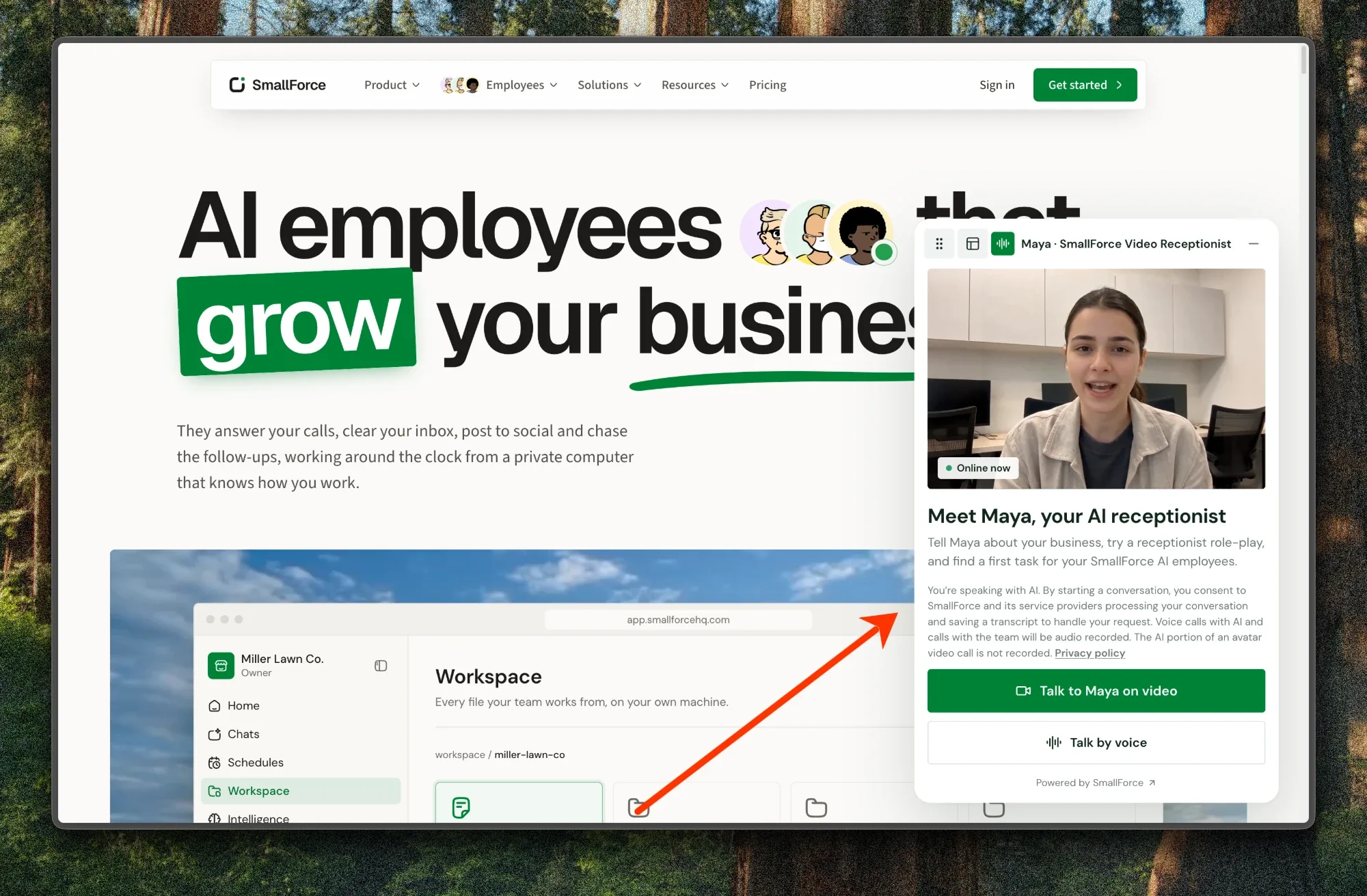
We found no video avatar in Bland’s docs. Bland’s web widget is voice and chat, and chat messages cost 1¢ each.
Showing visitors around. With a few lines of setup, the receptionist can also see the page the visitor is on. It can scroll to the right section, highlight a price, and fill in or click form fields for them. Password, hidden and file fields are always off-limits, and you can mark any other part of your page as private. Maya, the assistant in the corner of this page, works this way, so ask her to find the cost table.
Handing off to a person. If a visitor wants a human, the receptionist can ring your team in the SmallForce app. Your team can pick up in the browser or on an iPhone, by voice or video. A website voice call between a visitor and one of your team costs 1¢ a minute.
The AI employee version
This is the part with no Bland equivalent, because Bland sells a phone agent and SmallForce sells an AI operating system for your business.
Every SmallForce account runs AI employees on its own private machine. They connect to your apps, like Gmail, Outlook, Google Calendar and Slack, and you can message them in iMessage, Telegram or Slack. You can also give one a phone line.
Calling an AI employee means talking to the same employee that already has your inbox and calendar connected. For example, you could call from the truck and ask what a customer emailed about this morning. By default, only numbers you allow can reach an employee’s line. The plan includes five connected accounts.
Why I’d pick it for a small business
1. It’s answering calls the same day. A local number included in the plan and a working receptionist in about five minutes. There’s no carrier to set up, no agent to promote, and no developer to hire.
2. It sounds like a person. New receptionists start on a speech-to-speech voice. Callers can interrupt and it stops to listen. You choose from 178 voices, or use your own.
3. One receptionist on the phone and your website. The same receptionist answers your number, talks to website visitors by voice, or appears as a video receptionist with a face. On your site it can walk visitors to the right page and help with your forms.
4. It handles the call from start to finish. It books into Google Calendar or Outlook, answers from your knowledge base, remembers returning callers, rings your team when a person is needed, and takes a message when nobody picks up. After every call you get a summary, and the call can start a workflow in your other apps.
5. You’re not locked into one model. You pick the voice engine and the model behind it. When a better model ships, you switch in a dropdown instead of waiting for a vendor to rebuild theirs.
6. Bills you can predict. One plan with the phone line included and per-second billing. On your website you set a daily credit limit and a maximum call length.
7. It grows into the rest of your business. The receptionist is the front desk of a larger system. The same account has AI employees that handle email, calendars, social posts and follow-ups, and you can message them in iMessage, Telegram or Slack.
If that sounds like your business, try the demo line above, then set up your own AI receptionist.
Where SmallForce falls short
- It only answers. There’s no outbound dialing, batch campaigns or voicemail detection.
- No texting. It doesn’t send or receive SMS.
- Hand-offs stay in the app. It rings your team in SmallForce rather than transferring to any outside phone number.
- No published compliance. SmallForce doesn’t publish SOC 2 certification or offer a HIPAA BAA, so it isn’t the pick for patient data.
- Not the cheapest on minutes alone. The pricing section below shows where Bland costs less.
Bland AI pricing vs SmallForce
What each side charges:
- Bland Start: $0 a month, 14¢ a minute, plus phone time at an unpublished pass-through rate. It’s capped at 100 calls a day and 10 at once.
- Bland Build: $299 a month, 12¢ a minute, plus phone time.
- SmallForce: $199 a month, including 6,000 credits (1 credit is 1¢). The phone line is included. Standard costs 12 credits a minute on the phone, which gets you about 500 minutes from the plan. Phonic, the speech-to-speech default, costs 20 a minute, about 300 minutes. Website calls cost 2 credits a minute less. Extra credits are sold in $20, $50 and $100 blocks at the same 1¢ rate.
| Minutes a month | Bland Start | Bland Build | SmallForce, Standard | SmallForce, Phonic |
|---|---|---|---|---|
| 300 | $42 + phone time | $335 + phone time | $199 | $199 |
| 1,500 | $210 + phone time | $479 + phone time | $319 | $439 |
| 5,000 | $700 + phone time | $899 + phone time | $739 | $1,139 |
- Bland Start 14¢ a minute, no monthly fee
- $210 + phone time
- Bland Build $299 a month + 12¢ a minute
- $479 + phone time
- SmallForce, Standard voice $199 plan covers about 500 minutes, then 12¢ a minute
- $319
- SmallForce, Phonic voice $199 plan covers about 300 minutes, then 20¢ a minute
- $439
On minutes alone, Bland Start is $109 a month cheaper than SmallForce’s Standard voice, before Bland’s phone time.
Bland prices from bland.ai/pricing, checked November 16, 2026. Bland bills phone time on top at a rate it doesn’t publish. SmallForce prices are for phone calls and include the phone line; website calls cost 2¢ a minute less.
If all you’re buying is minutes, Bland Start costs less at the volumes in this table before phone time. At 5,000 minutes a month the gap to SmallForce Standard is $39. SmallForce’s 12¢ phone rate includes the line; Bland’s 12¢–14¢ rates add phone time, whose price isn’t published. Phonic costs more than Bland’s listed minute rates, but it’s a speech-to-speech option.
What the $199 plan includes:
- Your own private HQ: a private machine where your AI employees work, with 50 GB of business storage.
- As many AI employees as the work needs, in every role: receptionist, inbox, social, ads, reviews and more.
- A local US or Canadian phone number, free.
- 5 connected accounts, free, with unlimited posts: social media, Google Business Profile, review or ad accounts, counted together.
- 5 company mailboxes and website hosting.
- 6,000 SmallForce Credits for calls and media, and 2,500 AI Credits for your employees’ work.
Here’s what the difference buys:
- The parts a receptionist needs. Calendar booking, the hand-off to your team and the first phone number are included. On Bland, transfers are billed as extra minutes, warm transfers are Enterprise-only, and each number is $15 a month.
- Calls on your website too. The same credits pay for voice and video calls on your site.
- The AI employees. The plan includes 2,500 AI credits for employees that work in your email, calendar and other apps.
- No build project. There are no environments to promote and no webhooks to wire. You set the receptionist up in the dashboard and test-call it from there.
One caution on our side: SmallForce credits also pay for things like social posting, so a busy account won’t spend all 6,000 on calls.
2. Retell AI: the closest like-for-like swap
Retell charges a 5.5¢-a-minute platform fee, then adds the model, the voice and the phone time. Its published 7¢ to 31¢ range covers voice infrastructure, the voice and the model; phone time is extra. Numbers are $2 a month, and new accounts get $10 of credit.
You get what Bland doesn’t give you: a choice of language model, speech-to-speech models including OpenAI’s realtime family, built-in voice cloning, a visual flow builder, and an outbound dialer with SMS.
Best for: teams leaving Bland for outbound work who want more control and one per-minute bill.
Catch: speech-to-speech models aren’t available during the free trial. Prompts longer than 4,000 tokens are billed as extra time, and the transcript counts toward that limit.
Compliance: SOC 2 Type 1 and Type 2, HIPAA and GDPR. You can sign Retell’s BAA yourself at no extra cost on any plan.
3. Vapi: for developers who want every dial
Vapi charges 5¢ a minute for hosting and passes through the speech, model, voice and phone costs at each provider’s price, or you bring your own keys. Its calculator works out to roughly 8¢ to 13¢ a minute all in. Its usage-only plan costs nothing upfront and allows 4 calls at once; Core is $29 a month with 10.
Vapi supports OpenAI’s realtime models and runs outbound campaigns.
Best for: engineers who want to choose and pay for each component and are happy building in code.
Catch: the free number it gives you can’t make outbound calls. Vapi also retired its visual Workflows builder in August 2026 in favor of Squads, which you configure as handing-off assistants.
Compliance: SOC 2 Type II on every plan. HIPAA is a $2,000-a-month add-on that comes with a BAA.
4. ElevenLabs Agents: best voices and voice cloning
ElevenLabs Agents charges 8¢ a minute on every plan, from a free tier with 15 minutes to Business at $990 a month for 12,375 minutes. The language model is billed on top at the provider’s rate, and you connect your own Twilio or SIP number, so the carrier bills you separately.
The voices are the draw. ElevenLabs offers instant voice cloning from its $6 Starter plan, and since early November 2026 every account can use its own speech-to-speech models, Eleven Realtime Mini and Max. Agents can book into Google Calendar, Cal.com or Calendly, transfer calls, text over Twilio, and run outbound campaigns.
ElevenLabs also launched Reception in September 2026, a separate receptionist product for small businesses at $29, $79 or $199 a month for 75, 275 or 1,000 minutes, with a 14-day trial.
Best for: teams that care most about how the agent sounds, and want cloning and a flat platform rate.
Catch: 8¢ is the platform fee, not the total. You add the model, the carrier and a number. Voices from its Voice Library now carry a separate surcharge whose rate isn’t published.
Compliance: SOC 2 Type II and ISO 27001. A HIPAA BAA is only available on Enterprise.
5. Twilio ConversationRelay: build it yourself
ConversationRelay is Twilio’s voice layer for AI agents. Twilio handles the call, the speech-to-text and the text-to-speech, and your own server runs the AI and decides what to say. It costs 7¢ a minute, plus Twilio’s normal voice rates (0.85¢ a minute for an inbound local call) and $1.15 a month per number, plus whatever your language model costs.
Twilio retired its earlier AI Assistants product. For connecting an agent to Twilio’s calls and messages it now points developers to Agent Connect, a code library that became generally available in May 2026.
Best for: engineering teams already on Twilio who want full control of the model and the logic.
Catch: it’s a component, not a product. Booking, CRM, call summaries, testing and hosting are all yours to build and run. Speech-to-speech isn’t part of ConversationRelay; you’d wire it up yourself through Twilio Media Streams. If you’d rather not build any of that, SmallForce comes with booking, call summaries and hand-offs out of the box.
Compliance: SOC 2 Type II. ConversationRelay is HIPAA-eligible, but a BAA needs Twilio’s paid Security or Enterprise Edition.
6. PolyAI: large multilingual contact centers
PolyAI builds managed voice agents for big contact centers in hospitality, banking and utilities, and plugs into Genesys, Five9, NICE CXone and Amazon Connect. It handles inbound and outbound calls, texts, and hand-offs to human agents.
It opened self-serve sign-up in May 2026, but it doesn’t publish what the platform costs to run. Production pricing still comes from a sales conversation. Its own model, Dialog-RSN-1, takes audio in but replies in text, so it isn’t full speech-to-speech.
Best for: large, multilingual contact centers that want a managed agent and a team behind it.
Catch: you can try it, but you can’t see what it will cost in production. Custom voices are enterprise-only and take two to four weeks. SmallForce publishes every price and lets you clone your own voice from the dashboard.
Compliance: SOC 2 Type II, ISO 27001 and GDPR. On HIPAA it says its systems are “designed to meet” the requirements, with no BAA terms published.
7. Goodcall: a flat price per caller for trades
Goodcall is an AI receptionist for small businesses that charges per caller instead of per minute. Starter is $79 a month for 100 unique callers, Growth is $129 for 500, and Scale is $299 for 2,000. Extra callers cost 79¢, 26¢ or 15¢ depending on the plan. A caller counts once a month however many times they call, minutes are never metered, and spam doesn’t count.
You build the receptionist by describing your business in plain English. It books into Google Calendar, transfers calls, and texts you the lead when a call ends. A phone number is included.
Best for: plumbers, HVAC companies and salons with repeat or long calls who want a bill that doesn’t move.
Catch: $79 is a high entry price for a quiet month, and Starter connects only one outside tool (your calendar or your CRM, not both). We found no voice cloning, model choice or outbound calling on its pages. SmallForce gives you voice cloning and a choice of model, plus a receptionist on your website, though it doesn’t dial out either.
Compliance: its homepage says it’s SOC 2 and HIPAA compliant. It doesn’t publish BAA terms.
8. Dialzara: the cheapest published start
Dialzara is an AI receptionist for small businesses with plans at $29, $99, $199 and $349 a month for 60, 220, 500 and 1,000 minutes. Extra minutes cost 48¢ on the smallest plan, falling to 35¢ on the largest. A number is included, or you can forward your existing one, and there’s a 7-day free trial with no contract.
It writes a summary of every call, transcribes voicemail, and texts and emails you after each call. An AI texting agent comes free with any voice plan. Outbound calling is sold separately, from $750 a month.
Best for: a solo owner who wants the lowest published price to get every call answered.
Catch: 48¢ a minute adds up fast once calls get busy. Its pricing table puts warm transfer and calendar sync on the $99 plan and up, though another of its pages says booking is on every plan, so check before buying the $29 one. At 1,000 minutes a month, Dialzara’s Elite plan is $349; SmallForce’s Standard voice comes to about $259, with booking and the phone line included.
Compliance: a comparison page on its site calls it HIPAA compliant. It makes no SOC 2 claim and doesn’t publish BAA terms.
9. Synthflow: no longer a self-serve option
Synthflow used to be the no-code answer to Bland. Its pricing page now says it’s sold “as an annual enterprise agreement,” with no free plan, no trial and no per-minute rate. Since August 2026, accounts outside Enterprise can only use Synthflow’s own model.
Best for: contact centers buying a sales-led rollout.
Catch: if you’re a small business looking to sign up this week, it’s off the list.
How to choose a Bland AI alternative
Five questions sort most buyers:
- Do you make calls or answer them? For outbound campaigns, look at Retell, Vapi, ElevenLabs or Bland itself. For answering your own phone, start with SmallForce, then compare Goodcall and Dialzara.
- Who will build it? If you have engineers, Vapi, Twilio and Retell give the most control. If nobody on your team writes code, pick a receptionist that works on day one. SmallForce is set up in about five minutes from the dashboard.
- What will a month cost, all in? Add the platform fee, the model, the phone time and the numbers. “Per minute” on a pricing page is often only one of those.
- Do you handle patient data? For HIPAA-regulated use, you need an eligible service and a signed BAA. Retell offers one on any plan at no extra cost, Vapi charges $2,000 a month for it, and ElevenLabs, Twilio and Bland reserve it for paid enterprise tiers.
- What happens after the call? Check whether you get summaries, outcomes and follow-up, or just a webhook you have to build on.
Moving off Bland
If you’re switching, Bland’s November 15 migration to Bland Agents means many teams are rebuilding anyway. A clean move looks like this:
- Copy your agent’s instructions and knowledge. Your prompt, FAQs and documents carry over to most tools as text.
- Sort out your phone number. Check with Bland what happens to numbers bought through it. On SmallForce you get a new local number included in the plan. If you already have a business number, most carriers let you forward it to the new one.
- Rebuild your tools. Webhooks you called from Bland become custom tools or API calls in the new platform.
- Run both for a week. Point a test number at the new agent first, compare the calls, then move your main number.
When Bland is the better pick
Stay on Bland if any of these is the job:
- Outbound calling. Bland dials, runs batch campaigns from a CSV and detects voicemail. SmallForce only answers.
- Texting. Bland can send SMS on its Enterprise and Agent Phone plans. SmallForce doesn’t send texts.
- Transfers to any number. Bland can transfer a call to an outside number. SmallForce hands off to your team inside its own app.
- Flowcharts. Bland’s agents can follow a visual flow. SmallForce works from your instructions, knowledge base and tools, with no flowchart editor.
- Your own carrier. Bland supports SIP trunks, number porting and bringing your own Twilio account. SmallForce sells local numbers in the US, Canada, the UK and Australia.
- Regulated enterprise work. Bland offers a BAA, on-prem deployment and published concurrency limits. SmallForce doesn’t publish a concurrency figure.
If any of these is central to how you work, Bland, or one of the developer platforms above, will serve you better.
The bottom line
Pick SmallForce if you run a small business and want your phone answered properly without building anything. It answers your number in about five minutes, sounds like a person, books into your calendar, rings your team when someone’s needed, writes up every call, and works on your website too. Behind it, AI employees take care of the follow-up in your email, calendar and other apps.
Pick something else if outbound campaigns, texting or patient data are the core of the job. For those, look at Retell, Vapi, ElevenLabs or Bland itself.
Next step: call Sophie, our demo receptionist, then start your own receptionist. It’s $199 a month, or $59 a week, with your private HQ, as many AI employees as you need, a free local number and 5 connected accounts included.
FAQ
Is SmallForce a good Bland AI alternative?
For a small business that needs its phone answered, yes. You get a receptionist answering a local number in about five minutes, speech-to-speech voices, a choice of AI model, calendar booking, call summaries and a hand-off to your team, for $199 a month with the phone line included. It isn’t the right swap if you need outbound calling, SMS or a HIPAA BAA.
What is the best Bland AI alternative?
It depends on the job. For a small business that needs its phone answered and appointments booked, SmallForce. For outbound work with more control, Retell AI. For developers who want to choose every part, Vapi. For the most natural voices, ElevenLabs Agents. For a large contact center, PolyAI.
Is there a cheaper alternative to Bland AI?
On platform fees, yes. Vapi starts at 5¢ a minute and Retell at 5.5¢, against Bland’s 14¢ on Start, but both add the model, the voice and the phone time on top. Dialzara starts at $29 a month for 60 minutes. SmallForce starts at 12¢ a minute on the phone with the line included, and 10¢ on your website, against Bland Start’s 14¢ plus phone time. Bland Start has no monthly fee, though, so at low volume it still costs less.
Bland AI vs Retell AI: which is better?
Retell is the closer match for teams that make outbound calls. It lets you choose the language model, offers speech-to-speech models and voice cloning, and lets you sign a BAA on any plan. Bland suits companies that want its own closed models, enterprise support and on-prem options.
Which Bland AI alternatives offer a HIPAA BAA?
Retell lets you sign one on any plan at no extra cost. Vapi charges $2,000 a month for HIPAA. ElevenLabs, Twilio and Bland offer a BAA only on enterprise or paid security tiers. SmallForce doesn’t offer one today.
How much does Bland AI cost?
As of November 16, 2026, the Start plan is free with 14¢ a minute, and Build is $299 a month with 12¢ a minute. Phone time is billed on top at a rate Bland doesn’t publish. Numbers cost $15 a month. Outbound attempts and failed calls cost 1.5¢ each, and SMS costs 2¢ a message. Enterprise pricing is custom.
Is Bland AI good?
For high-volume outbound calling run by a technical team, yes. The few public reviews on G2 praise how realistic the voices sound and how well agents stay on script. The complaints that come up most are bills that are hard to predict and a steep setup. Dedicated support and engineers come with Enterprise.
Does SmallForce make outbound calls?
No. SmallForce’s AI answers inbound calls and website visitors. It doesn’t dial out or send texts.
Does the SmallForce receptionist come with a phone number?
Yes. One local US or Canadian number is included with every plan, and extra numbers are $4 a month. You can have the receptionist answering it in about five minutes.
Can callers talk to it in other languages?
Phonic voices speak 50+ languages. The default is English, and today the call language is set through the API rather than the dashboard.
Do I need a developer to set up SmallForce?
No. Custom API tools are there for developers who want them, but booking, the knowledge base and the hand-off to your team work without code.