ManyChat Pricing 2026: Small Business Guide
ManyChat pricing now depends on monthly active contacts. See the 2026 costs, overage fees, hidden tradeoffs, and how SmallForce compares.
Rao
ManyChat has been one of the default names in Instagram and Messenger automation for years. If you wanted someone to comment a keyword on a Reel and automatically receive a DM, ManyChat was usually one of the first tools people recommended.
That still matters. ManyChat is a capable automation builder.
But in 2026, the pricing model deserves a closer look before a small business commits to it.
ManyChat’s newer plans are built around monthly active contacts. That means your cost is not only based on the features you want. It is also based on how many people engage with your automations each month.
For a small business, that creates a weird tradeoff:
If your marketing works, your active contact count rises. If your active contact count rises, your bill can rise too.
That is why business owners are comparing ManyChat with platforms like SmallForce, which gives small businesses AI tools for social media, inbox management, front desk calls, reviews, and content creation without charging social users based on monthly active contacts.
This guide breaks down ManyChat’s 2026 pricing, where the hidden costs show up, and when SmallForce may be the better fit.
ManyChat pricing at a glance
ManyChat says its newer pricing model, introduced on March 2, 2026, includes Free, Essential, Pro, Business, and Advanced plans. The same help article notes that plan availability can vary by region and that the new model currently applies to accounts created on or after March 2, 2026. (ManyChat Help)
Here is the current plan structure ManyChat lists in its help center:
| Plan | Monthly billing | Annual billing | Included active contacts |
|---|---|---|---|
| Free | $0 | $0 | 25 |
| Essential | $17/mo | $14/mo | 250 |
| Pro | $39/mo | $29/mo | 2,500 |
| Business | $99/mo | $69/mo | 7,500 |
| Advanced | $199/mo | $139/mo | 25,000 |
The headline prices are not the whole story. The number to pay attention to is the active contact limit.
ManyChat defines an active contact as someone who interacts with your business through ManyChat during the current billing month, such as sending a DM, commenting on a post, replying to a story, or engaging with an automation. Active contacts reset each billing cycle. (ManyChat Help)
For Instagram, Facebook Messenger, TikTok, WhatsApp, SMS, email, and Telegram automations, that number can grow quickly.
The real issue: ManyChat charges based on engagement
ManyChat’s pricing model makes sense for a chatbot platform. More conversations usually means more platform usage.
But for a small business owner, it can feel backwards.
Your goal is to get more engagement. You want people commenting, replying, asking questions, claiming offers, booking appointments, requesting prices, and starting conversations.
With active-contact pricing, that growth can move you into a higher plan or trigger overage charges.
ManyChat currently lists these overage rates:
| Plan | Included active contacts | Monthly overage | Annual overage |
|---|---|---|---|
| Essential | 250 | $0.10 per extra active contact | $0.08 per extra active contact |
| Pro | 2,500 | $0.05 per extra active contact | $0.038 per extra active contact |
| Business | 7,500 | $0.025 per extra active contact | $0.018 per extra active contact |
| Advanced | 25,000 | $0.004 per extra active contact or less | $0.0028 per extra active contact or less |
ManyChat publishes these rates across its plan help docs. I am not linking each plan individually here because the important takeaway is the pricing model: once you pass your included active contacts, each additional active contact can add cost.
So the pricing question is not just:
“Can I afford $29/month?”
It is:
“What happens if my campaign actually works?”
ManyChat Free: useful for testing, not running a business
ManyChat’s Free plan includes up to 25 active contacts per month and up to four live automations. It is useful if you are brand new to automation and want to understand how the product works.
But 25 active contacts is not realistic for a business that plans to run comment-to-DM campaigns, lead magnets, giveaways, promotions, or automated sales conversations.
A single local giveaway, ad, Reel, or “comment OFFER” post can pass 25 active contacts almost immediately.
Treat the Free plan like a testing environment. It can help you learn the platform, but it is not enough for a real marketing system.
ManyChat Essential: affordable, but easy to outgrow
Essential is where ManyChat starts to become usable for small campaigns.
At $17/month, or $14/month when billed annually, it includes 250 active contacts per month. That may be enough for a creator, solo owner, or local business running one or two simple automations.
Essential can work if you want to:
- Send a link after someone comments a keyword
- Deliver a lead magnet
- Collect basic contact information
- Run simple auto-replies
- Avoid complex sales conversations
The issue is the ceiling. If one post performs well, or you run ads, or your audience is moderately engaged, 250 active contacts can disappear quickly.
ManyChat Pro: the practical starting point for growing businesses
For many businesses, Pro is the first ManyChat plan that feels realistic.
It includes 2,500 active contacts per month and costs $39/month, or $29/month when billed annually. It also opens up more channels and automation capability than the lower tiers.
Pro can be good value when you know exactly what you want to automate:
- Comment-to-DM lead magnets
- Basic qualification flows
- Keyword-based responses
- Promotional campaigns
- Simple customer routing
But Pro does not remove the main operational challenge: you still need to build the conversation path.
You decide the branches. You write the fallback messages. You maintain the flows. You test edge cases. And when customers ask questions in their own words, the automation may still need a human to step in.
That is fine for simple marketing flows. It becomes harder when you are trying to handle real customer conversations.
ManyChat Business and Advanced: more room, same pricing logic
Business gives you 7,500 active contacts and lower overage rates. Advanced gives you 25,000 active contacts and custom-style scaling for higher-volume use.
These plans make sense for larger teams, agencies, or businesses where messaging automation is already central to the funnel.
But the pricing logic stays the same.
You still have an active-contact allowance. You still need to watch monthly usage. And ManyChat states that active contacts are calculated monthly even when you choose an annual plan, with overage charges billed monthly if you exceed your limit.
Annual billing can lower your base subscription price. It does not remove contact-based pricing.
The hidden costs of ManyChat
ManyChat’s public pricing tells you the subscription cost. The real cost includes more than the monthly fee.
1. Your bill can rise when your audience grows
This is the biggest pricing issue for small businesses.
ManyChat can look inexpensive when your audience is small. But once automations start getting traffic, the economics change.
A gym, med spa, dental clinic, restaurant, real estate agent, coach, salon, or home service business can easily generate hundreds or thousands of interactions from one strong campaign.
That is good marketing. It can also mean a higher software bill.
2. You still need to build and maintain flows
ManyChat is a builder. The value depends on what you build inside it.
A strong flow requires planning:
- What triggers the automation?
- What should the first message say?
- What happens if the customer says yes?
- What happens if they say no?
- What happens if they ask a different question?
- When should a human step in?
- How should follow-up work?
For a business owner, that takes time. For an agency, it takes billable hours.
That cost does not show up on the pricing page, but it is real.
3. Flow-based automation can feel robotic
ManyChat works best when the customer follows the path you designed.
Customers rarely behave that neatly.
They ask about pricing in odd ways. They compare services. They send half-complete questions. They object. They need reassurance. They ask for a recommendation. They may reply with one word or a paragraph.
Rigid automation can start to feel like a menu instead of a conversation.
For trust-based businesses like clinics, consultants, agencies, home services, real estate, beauty, fitness, and professional services, that matters.
4. ManyChat is not a complete small business operating platform
ManyChat is mainly focused on chat marketing and automation.
That is useful, but it is only one part of running a business.
Most small businesses also need to:
- Create social posts
- Schedule content
- Reply to comments
- Manage DMs
- Handle customer calls
- Generate graphics
- Respond to reviews
- Track performance
- Keep customer conversations organized
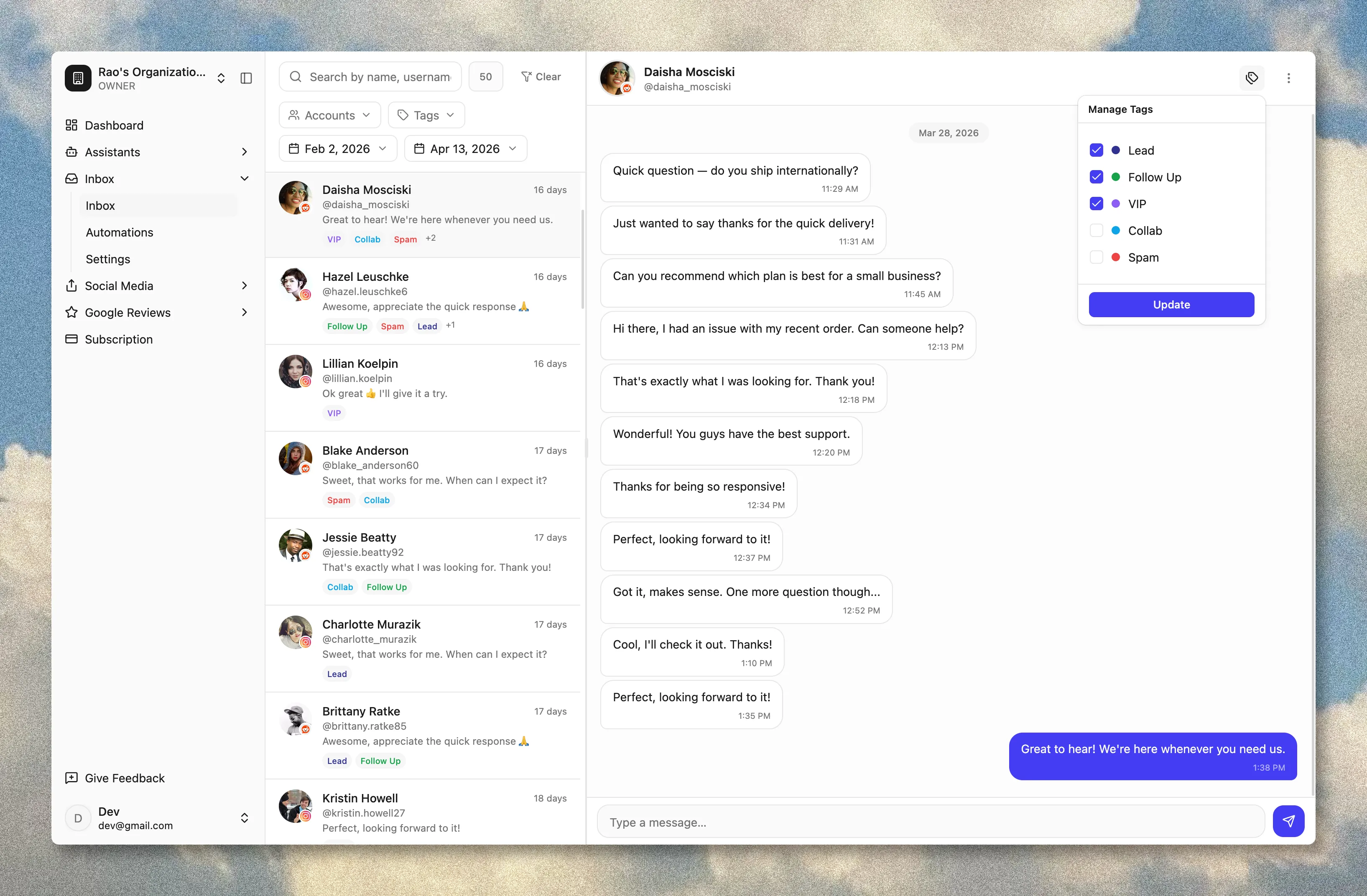
That is where SmallForce social media automation takes a different approach.
SmallForce vs ManyChat: a different approach
SmallForce is not just a ManyChat replacement.
It is built around a different idea: small businesses should have AI employees that help operate the business, not just automate one message channel.
SmallForce includes AI tools for front desk calls, social media management, inbox management, design, and Google reviews. It also supports knowledge-grounded AI, so assistants can use your business’s own documents, website content, FAQs, menus, services, policies, prices, and custom information.
That makes SmallForce especially useful when you want more than a comment-to-DM tool.
SmallForce social pricing
SmallForce’s social pricing is simpler for small businesses:
| Plan | Price | Social profiles | Social contact limit |
|---|---|---|---|
| Starter | $19/month | 1 social profile | Unlimited contacts |
| Growth | $49/month | 2 social profiles | Unlimited contacts |
Both plans include a 3-day free trial.
The important difference is that SmallForce does not charge social users based on active contacts.
That means your social cost does not jump just because more people comment, reply, or interact with your business.
SmallForce Starter: for solo business owners
SmallForce Starter is designed for business owners who manage one brand or social profile and want a practical place to create, schedule, publish, and manage engagement.
Starter includes:
- 1 social profile
- Instagram, Facebook, LinkedIn, X, TikTok, YouTube, Google Business, and Reddit support
- AI-powered post composer
- Post scheduling and calendar
- Basic analytics
- Comment management
- Multi-platform publishing
- Unlimited contacts
For $19/month, Starter gives a solo owner a social media command center without active-contact pricing.
It is a strong fit for local businesses, consultants, creators, service providers, and solo founders who want to stay active online without turning social media into a full-time job.
SmallForce Growth: for automation and reporting
SmallForce Growth is the better fit when you need more capability.
Growth includes everything in Starter, plus:
- 2 social profiles
- Advanced scheduling and calendar
- Full analytics and reporting
- Comment automations and DM bots
- Priority support
- Team collaboration
- Unlimited contacts
At $49/month, Growth sits above ManyChat Pro’s annual base price and below ManyChat Business’s annual base price. But unlike ManyChat, it does not cap social usage by monthly active contacts.
For a growing business, that predictability matters.
You can run campaigns, increase engagement, and manage more conversations without wondering whether a successful month will push you into extra fees.
ManyChat vs SmallForce
| Feature | ManyChat | SmallForce |
|---|---|---|
| Core purpose | Chat automation builder | AI workforce for small business |
| Pricing model | Active contact-based | Flat social plans with unlimited contacts |
| Free/testing option | Free plan | 3-day free trial |
| Comment-to-DM automation | Yes | Yes, on Growth |
| DM bots | Yes | Yes, on Growth |
| Social post creation | Not the main focus | AI-powered post composer |
| Post scheduling | Not the main focus | Included |
| Multi-platform publishing | Channel and use-case dependent | Included across major platforms |
| Comment management | Automation-focused | Included |
| Analytics | Plan-dependent | Basic on Starter, full reporting on Growth |
| Team collaboration | Plan-dependent | Included on Growth |
| AI front desk/calls | Not core product | Available through SmallForce Front Desk |
| Review management | Not core product | Available through Google Reviews tools |
| AI design tools | Not core product | Available through SmallForce Designer |
| Contact limits | Yes | No social contact limit |
The difference is clear.
ManyChat is a tool for building automations. SmallForce is a broader platform for helping run the business with AI.
When ManyChat makes sense
ManyChat can still be a good choice.
It makes sense if your main need is chat automation and you are comfortable building flows yourself.
Choose ManyChat if:
- You mainly want comment-to-DM campaigns
- Your conversations are predictable
- You do not need social scheduling or content creation
- You are comfortable watching active contact limits
- You already know how to build chatbot flows
- You want a specialized automation platform
ManyChat is strongest when the customer journey is simple:
Comment a keyword. Receive a link. Click a button. Join a list. Get a follow-up.
For that, it works.
When SmallForce makes more sense
SmallForce makes more sense when you want one AI-powered platform to help with more of your daily business operations.
Choose SmallForce if:
- You want unlimited social contacts
- You do not want engagement-based pricing
- You need content creation and scheduling
- You manage comments and DMs
- You want automations without living inside a flow builder
- You want analytics and reporting
- You want AI tools beyond chat automation
- You want front desk, social, inbox, design, and review capabilities in one platform
For many small businesses, the problem is not just:
“We need a chatbot.”
The real problem is:
“We need help running the business.”
That is the problem SmallForce is built to solve.
Example: a local business running a social campaign
Imagine a local med spa, gym, restaurant, dental clinic, or home service business runs this campaign:
“Comment OFFER and we’ll send you the details.”
The post performs well and gets 1,000 interactions.
With ManyChat, those interactions can count toward active contact usage for the billing month. Depending on your plan and current usage, that campaign could move you toward a higher tier or overage charges.
With SmallForce, the business can manage comments, create and schedule content, publish across platforms, and handle social engagement without a per-contact social limit.
That makes SmallForce easier to budget for.
FAQ
How much does ManyChat cost in 2026?
ManyChat’s newer 2026 pricing model lists Free, Essential, Pro, Business, and Advanced plans. The public help center currently shows Free at $0, Essential at $17/month, Pro at $39/month, Business at $99/month, and Advanced at $199/month, with lower base prices when billed annually.
What are active contacts in ManyChat?
Active contacts are people who interact with your business through ManyChat during the current billing month. That can include DMs, post comments, story replies, or other automation engagement. The same person generally counts once per billing month on the same connected identity.
Does ManyChat charge overage fees?
Yes. Under the newer active-contact pricing model, paid plans include a monthly active contact allowance. If you exceed that allowance, ManyChat can apply per-contact overage charges based on your plan and billing cycle.
Is ManyChat good for small businesses?
ManyChat can be a good fit for small businesses that want structured chat automation, especially comment-to-DM campaigns and simple lead capture flows. The tradeoff is that you need to watch active contact limits and maintain the automations yourself.
What is the best ManyChat alternative for small businesses?
SmallForce is a strong ManyChat alternative for small businesses that want social media scheduling, comment management, DM bots, analytics, and AI tools beyond chat automation. The biggest pricing difference is that SmallForce’s social plans do not charge based on active contacts.
The bottom line
ManyChat is a strong automation builder, especially for comment-to-DM campaigns and structured message flows.
But its 2026 pricing model means small businesses need to pay attention to active contact limits, overage fees, and the time required to build and maintain flows.
If you only need a simple chatbot flow, ManyChat may be enough.
But if you want a broader AI platform that helps with social posting, scheduling, comment management, DM bots, analytics, front desk calls, reviews, and content creation, SmallForce is the better fit.
SmallForce gives small businesses something more useful than another bot builder:
An AI-powered workforce that helps run the business with unlimited social contacts and predictable pricing.
View SmallForce plans or learn more about SmallForce social media automation.